Benko Chess Club

Learn Chess

Interactive exercises on Lichess help students recognize tactical motifs, mating patterns and hidden possibilities in a position. Practice develops combinational vision, concentration and calculation skills.

Puzzle-based training

Lichess Exercises for Improvement

Each card leads to a specific group of puzzles: forks, pins, sacrifices, zugzwang positions and mating motifs. The goal is not to guess moves, but to learn how to calculate, compare ideas and find the best continuation.
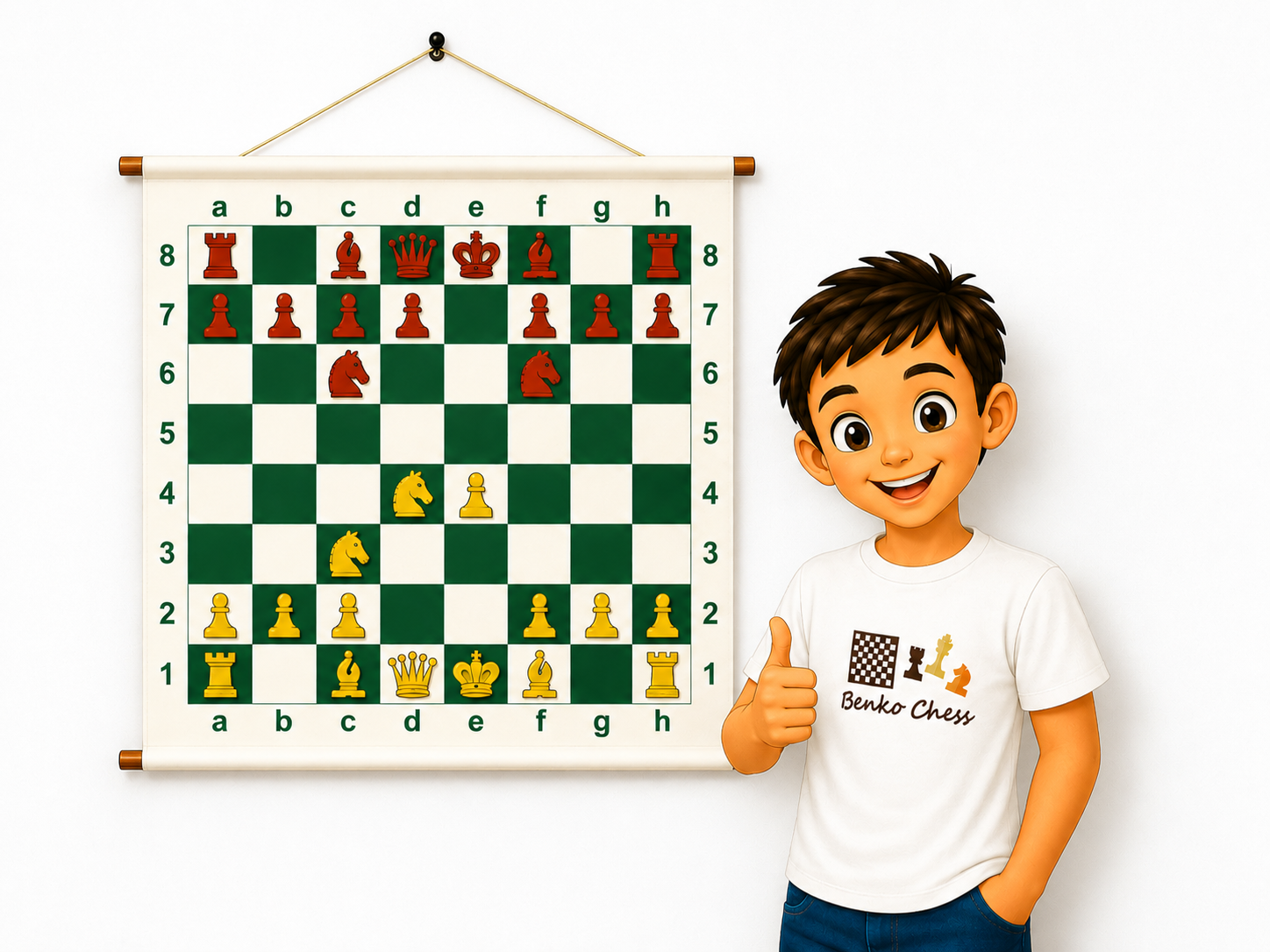
Introduction to the World of Chess

The first step is for a child to understand why chess is a special game and what can be learned by thinking at the board.

Chess as a School of Thinking

Chess is not just a game played on 64 squares. It is a school of thinking, patience, respect for the opponent and the courage to make decisions.

“Chess is more than a game – chess is a school of life.”
Benko Chess message: A child who learns chess learns to pause, think, make a plan and accept the consequences of a decision.
Benko pored demonstracione table
IM Petar Benković / Club Founder

Basic Tactical Motifs

This section presents the basic tactical motifs every young chess player should recognize. Each card links to Lichess exercises featuring the same motif.

📌

Pin

A piece cannot or should not move because a more valuable piece stands behind it.

Practice on Lichess →
🪡

Skewer

A more valuable piece is attacked; when it moves away, a less valuable piece behind it can be won.

Practice on Lichess →

Advanced Pawn

A pawn deep in the opponent’s position often threatens promotion or ties enemy pieces to its defense.

Practice on Lichess →
🛡️

Removing the Defender

A piece defending an important square or another piece is removed, weakening the opponent’s defense.

Practice on Lichess →
🔥

Sacrifice

Material is given up temporarily in order to obtain an attack, checkmate or a larger advantage after forced play.

Practice on Lichess →

Zwischenzug

Instead of the expected move, a forcing move is played first, creating a threat that demands an immediate response.

Practice on Lichess →
♟️

Zugzwang

The opponent is to move, but every legal move worsens the position. This is the well-known chess concept of zugzwang.

Practice on Lichess →

Basic Mating Patterns

These are well-known mating patterns that often occur in games. Recognizing them makes it much easier to find the final attack on the king.

Anastasia’s Mate

A knight and rook or queen work together to trap the enemy king between the edge of the board and its own pieces.

Practice on Lichess →
🏰

Back-Rank Mate

The king is checkmated on its back rank because its own pieces or pawns block the escape squares.

Practice on Lichess →

Boden’s Mate

Two bishops attack along crossing diagonals and mate a king whose own pieces block its escape.

Practice on Lichess →

Smothered Mate

A knight checkmates a king that cannot move because it is surrounded by its own pieces.

Practice on Lichess →

Balestra Mate

A bishop gives checkmate while the queen controls the enemy king’s remaining escape squares.

Practice on Lichess →

Pillsbury Mate

A rook gives checkmate while the bishop helps confine the enemy king and remove its escape squares.

Practice on Lichess →

Morphy Mate

A bishop checks the king while a rook controls an important line and prevents the king from escaping.

Practice on Lichess →
🎭

Opera Mate

A rook gives checkmate while a bishop protects it and helps confine the enemy king.

Practice on Lichess →
🪝

Hook Mate

A rook, knight and pawn cooperate, often using an enemy pawn as part of the mating net.

Practice on Lichess →

Triangle Mate

A queen and rook stand close to the enemy king on the same rank or file and together form a mating net.

Practice on Lichess →

Blind Swine Mate

Two rooks cooperate to mate the king in a confined area, usually within just a few squares.

Practice on Lichess →

Mate in 1, 2 and 3 Moves

These exercises teach us not to look only for the first check, but to find the correct finishing plan: immediately, in two moves, or through a short forced line.

2

Mate in 2

Calculate the first move and the forced continuation that checkmates the king on the next move.

Practice on Lichess →
3

Mate in 3

Practice calculating a short forced line and find the plan that leads to mate in three moves.

Practice on Lichess →